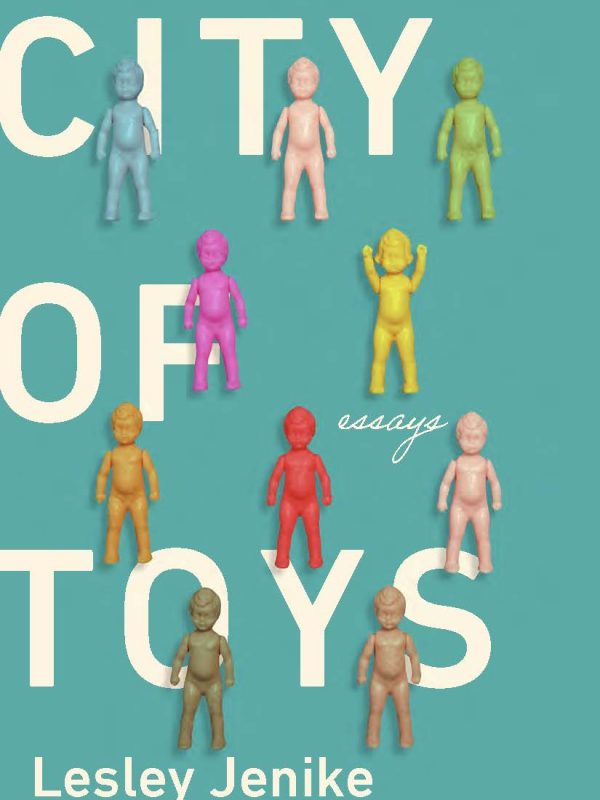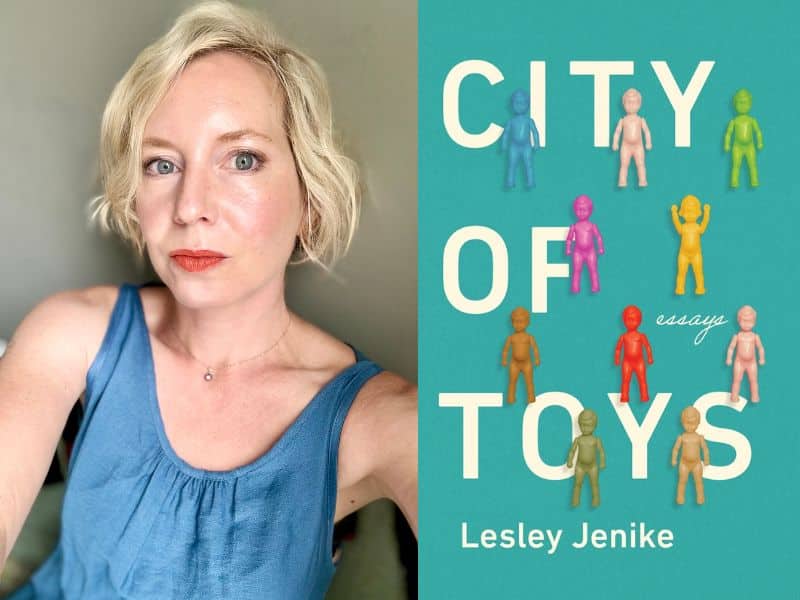
CCAD writing professor Lesley Jenike discusses her new book of essays, City of Toys, writing while parenting, and how to publish your work.
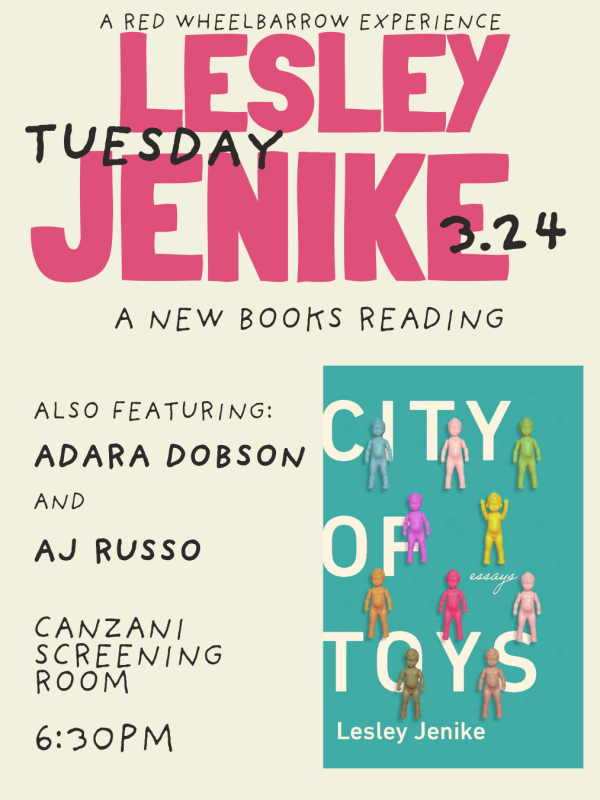
Two members of the Botticelli PR team, Abigail Bobst and David Ruiz, recently sat down with Dr. Lesley Jenike to chat about her new book, City of Toys, available now from Mad Creek Books. Professor Jenike will read from City of Toys tonight, March 24, at 6:30pm in the Canzani Center Screening Room. The event is open to the public. This interview has been edited for clarity and length; you can listen to the edited audio here.
Abigail Bobst
Just for anybody who may not be aware, or has never taken your classes before, if you wouldn’t mind doing an introduction of who you are, what you do, what you’re interested in, weird facts; whatever you want to start with.
Lesley Jenike
Okay, so I’m a professor of writing literature and philosophy here at CCAD, and I teach a lot of different things. I teach creative writing classes, poetry and nonfiction, and I teach various literature classes. I teach 21st century contemporary American lit, I’ve taught 19th century American lit, I teach Shakespeare class, I sometimes teach 1290 – the first-year composition class. And in the past, I’ve taught screenwriting weirdly – all sorts of things. Oh! And I teach film and lit in the Fall…
Abigail Bobst
So that sounds like a smorgasbord of different stuff.
Lesley Jenike
It’s a total smorgasbord.
Abigail Bobst
That’s kind of fun. Or is it kind of hectic? Is it kind of overwhelming? Like ‘Am I teaching film writing this semester? Or am I teaching Shakespeare and creative writing’?
Lesley Jenike
Well, I make it more hectic than I need to. I always want to change up what I’m teaching to keep it interesting for me. I just get really bored. And so I have to do new things almost every semester…Like Shakespeare: I taught three different plays last Spring. And some of them I know really well, and some of them I know less well. So, it’s a lot of work, you know? But it keeps my mind going.
Abigail Bobst
Well, moving on from you as a person: We wanna talk about City of Toys. It just released, I think, on March 9th? Just for anybody who may not be aware, if you could briefly describe what this book is about – just off the dome.
Lesley Jenike
Oh geez. Okay.
Abigail Bobst
I know it’s about a lot of stuff- I’ve seen, but…
Lesley Jenike
It’s about a lot of stuff, yeah. Actually, I was just talking to my editor. She was selling the book at the AWP Book Fair and she was like, “I feel bad because people would come up and I would try to quickly describe what this book is and I couldn’t really do it.” … This is a book of essays that were written just after my kids were born, or when they were small children. So they’re about me learning how to be a parent. And parenting is really boring. You spend a lot of time reading little children’s books over and over and over again. I can’t tell you how many countless hours I’ve spent at COSI. So if you have imagination, you have to find a way to make these things interesting for yourself. So a lot of the essays are about me going to the museum with my kids and thinking about that. Or me reading these stories that often feature animals – you know, anthropomorphized animals – and like, what does all that mean? And then some of the essays are thinking back to when I was a kid. I went to a performing arts school. I was a singer, I did all kinds of performing ever since I was little. So a lot of the essays were about that, and about childhood imagination, childhood talent – how it can be exploited, unfortunately. Or how do we encourage it in our own children without exploiting them?
Abigail Bobst
Yeah, I read another interview you did for Matter in Columbus. And I imagine being a mother yourself and also a teacher and also a writer – your writing process has got to be insane, and also probably very spontaneous. And from what I gathered from that interview, it kind of seems like the book itself is spontaneous too…. You said in the interview that you connected to Harambe from the zoo, and your crush on the zookeeper. So it seems like you do a really good job at connecting all these different things and these little pieces of your life into this one big narrative.
Lesley Jenike
Actually, that’s a good point. I already have an associative brain, but parenthood really emphasized that aspect of the way I think. Because parenthood is really boring, but it’s also about interruptions. You’re constantly getting interrupted. So you start to think for a while, and then, ‘I need a snack!’ Or when they were really little, they’d need a diaper change. And so, you can’t sustain a thought for very long. And so maybe there is a fragmented kind of aspect to that. Parenting even now is like that. But especially back then, I was in a daze most of the time. I wasn’t sleeping well. If I did catch a moment when I could do some writing, then I probably immediately got interrupted, thought of something else, and then made some weird connection that I wouldn’t have if I had been in my right mind.
Abigail Bobst
‘Your right mind’…
Lesley Jenike
I think parenting totally encouraged that kind of weird, fragmented, associative quality.
Abigail Bobst
I cannot imagine – being an artist myself – having to take care of little people, and all their needs on top of being creative. I think that would just be insane. And, so it probably does contribute to a very spontaneous output. But, I think that’s also really exciting in your book.
Lesley Jenike
So before I had [my] kid, I’d been playing around with sentences more than with line breaks and poetry…And I got a call from The Fairytale Review, which is a literary magazine based out of Alabama, and they wanted me to write a blog post. And so I [wrote] about “The Red Shoes,” the Hans Christian Anderson fairy tale, and I was like, ‘Why don’t I do this more often? Like why don’t I write prose more often? This is just fun. This is what I like to read more often.’ So I just started writing essays. And if you write a long piece like that, you can put it down, go away from it, and come back to it. And it’s always fun to come back to it, because it’s like, ‘this is my time’. Obviously you can write a poem, go away from it, come back, fiddle with it, go away. But there’s something about that long form. I was able to use it as an escape… I think a lot of things converged at that time in my life to move me into the long-form essay. And I think a lot of it had to do with how fractured my time was, how I was trying to entertain myself when I was bored, and just wanting to have something that felt like a friend that I could come back to. And the essays felt like they were just sitting there waiting for me. I could keep adding to it and adding to it in little drips and drabs.
Abigail Bobst
I think that’s a really interesting way to think about it. I would have thought if you were super busy with your time being a professor and a mother and all that, you would want to write shorter-form.
Lesley Jenike
Right!
Abigail Bobst
But then there’s the pressure to have that be completed. Whereas an essay, you can just keep adding onto it until you reach the point where you’re like, ‘oh, this is the conclusion.’
Lesley Jenike
Yes, it seems a little counterintuitive. You’d think it would be shorter forms that would be appealing to somebody in my situation. But I want to immerse myself in a more complicated critical inquiry, and keep working on it in my head when I’m able to. And then when I’m able to go back to the page, I [have] it there for me as something I’m working on a little bit at a time, over a long period of time. There was something about that which was really appealing to me.
Abigail Bobst
I get you. Okay, moving on: So this is for Botticelli. We’re a literary publishing class. We’re interested in your journey with how you got City of Toys published. You’ve had other books published, but how does the experience of publishing this book compare?
Lesley Jenike
Okay. So…I started sending it out [around] 2020-2021? And I sent it to some contests. When poets publish, they generally have to send to an open submission, or if there’s a contest, [they’ll] publish the winner of the contest. So as a poet, I automatically was like, ‘Well, I’ve got to send it to contests!,’ without really thinking it’s probably a slightly different process. So I sent it to some contests, and it was the runner-up once or twice, it was a finalist a couple times, I kept sending it out. Finally, it was the runner-up for the Gournay prize from Ohio State Press… And they were like, “We want to publish it! Here’s the contract.” They probably alerted me in May or June. And then I had a contract by August. And then, radio silence for a long time, because the editor was going through some health issues. And so, it just got back-burnered and back-burnered…I was freaking out. I was like, “Oh my God, they’re trying to dump me.” I didn’t know what was going on. Finally, things kicked into gear about a year ago. And so, it took about a year to get all the accompanying information together. I had to fill out this huge form describing the book, listing comparable titles, how we would sell the book, places where I could go to sell the book, other colleges or universities that might want to host me. So I did all that – sent them a bunch of information – and then subsequently got a series of edited versions that I had to look at and work on. So that took many, many months. And then, I finally got the final proof, got the cover situation, had to work to try to get some blurbs, all of that stuff. So, long story short: It’s a long process. And it was especially long in my situation because of what happened.
Abigail Bobst
Right. Well, book publishing, in general, seems like an extraordinarily long process.
Lesley Jenike
Yes, it is.
Abigail Bobst
Any undertaking like that is gonna be. With all the contracts, and the editing, and – yeah.
Lesley Jenike
And you know, it’s prose too. So it’s just that much more to go through. Prior to this, I had only published poetry. And sure, there were edits and there were versions I had to work through. But it wasn’t nearly as onerous. I had to fill out permissions, making sure that things were fact-checked. All of that stuff I never had to worry about before.
Abigail Bobst
Creative nonfiction.
Lesley Jenike
Creative nonfiction. Exactly. I had to go through all of that. What’s interesting is a friend I went to grad school with was the fact checker. So, in a way, that was really nice, because I just felt more comfortable talking to him about it…
Abigail Bobst
That’s interesting. I didn’t know there was a job for fact-checking books.
Lesley Jenike
A lot of different people did editorial passes. It wasn’t just one person. He did an editorial pass, and then he fact-checked some things along the way, and had questions about certain things.
Abigail Bobst
I imagine when you completed the book to when it was published – I wonder if that distance of time made you reflect back on it differently at all? Have you read the book since publishing it?
Lesley Jenike
I re-read it during the editing process. And I have to say – and I never say anything like this ever, because I am the most self-pessimistic person on the planet – but I was like, ‘This is good. This is really good!’ I’m really proud of it. There are moments where I’m like, ‘I did this?’ I kind of couldn’t believe it. And I think part of that is because I wrote it when I was out of my mind. Or as a writer, there are those rare times when you get in a flow state. And it’s almost like you’re tapping into something unconscious. So you don’t necessarily remember writing it…
Abigail Bobst
I think there’s a similar thing I experience sometimes in art. Where – especially with the pieces I’m super proud of – the thought isn’t, ‘Whoa, I did that!’ It’s more like, ‘Who did this? Who put this on my page?’
Lesley Jenike
Yes! Exactly. It’s the weirdest thing
Abigail Bobst
It’s imposter syndrome or something, I don’t know.
Lesley Jenike
I don’t know…Or we could be mystic about it and say, ‘The muse was communicating with you on that day and your conscious self – your ego – stepped aside for a minute’
Abigail Bobst
I like being a little bit mystic about it.
Lesley Jenike
Yeah, why not?
Abigail Bobst
It’s interesting. And then, this is the trademark question we’ve got to ask: Do you have any advice for students who are interested in publishing their own works? It sounds like one of the big ways you got out there was just submitting to local competitions.
Lesley Jenike
A lot of it depends on what it is that you’re trying to publish. A lot of folks who go to CCAD are interested in genre fiction, YA [young adult], in which case, trying to get an agent might be a smart move. And that’s something that I personally don’t have any experience with. But if you are a poet or a creative nonfiction writer, that might not be your first concern. Your first concern may be to look for small, independent presses with open reading periods or contests that you can submit to. And I’m always happy to talk to people, because the answer is always gonna be a little different. Another thing I would recommend: If you write short things – like short stories, essays, self-contained pieces – it’s always a really good idea to try to get them into literary magazines first. Because that adds legitimacy to your work. So when an editor comes across it, they’re like, ‘People are responding to this work, there’s already an audience for it.’ It’s always a smart move. But that’s not really something that’s doable if you’re writing longer form…You could try to publish an excerpt, but that could be tricky…
Abigail Bobst
And it sounds like one of the big things you’re saying is to stay local first…
Lesley Jenike
Again, it really depends on what kind of work you do. My work is really weird. The Big Five are probably not gonna be into it. So I’m going to look to small, independent presses. I’m gonna look at university presses that are more keen to publish experimental work. If you’ve got the next awesome thriller / true crime thing going on that you think tons of people are going to be into, then [maybe]. But you’re gonna have to get an agent first, because they’re not gonna take on non-agented submissions with those big places. But a memoir with a really clear, interesting story – those are the kinds of things that agents are looking for. So again, it all depends on what kind of thing you’ve got…
Abigail Bobst
Interesting. I’m learning a lot from this class, and from this interview, and about publication. Another question I had: So a lot of artists and writers in general are very sensitive when it comes to rejection. And City of Toys – it didn’t get rejected – but it came in runner-up. But you still kept submitting it to places. I’ve always heard the advice that you gotta get a thick skin when it comes to rejection, or just power through. Try to get 10,000 rejections, and then by the time you try to reach that goal, somebody will take you.
Lesley Jenike
Yes.
Abigail Bobst
Would you say that’s your experience?
Lesley Jenike
You have to think of submissions as a job. Try to just send stuff out and forget about it. Send it out as much as you can, to as many places as you can. When you get a rejection back, immediately send it out to somebody else. But that is if you feel good about the form that it’s in…I think you’re in a good spot in your career if you can get to a place where you’re like, ‘Yeah, I can kind of see how I was overzealous. I sent that out too soon, and it needs more time…’, versus, ‘This just hasn’t found the right audience yet.’ But if you send things out and you get rejected, but you get feedback, like, “This came really close,” or “We really liked this”, then that’s a good sign that you’re on the right track. A lot of situations are out of your control. Maybe they’ve already taken a book about pregnant ladies or something. And they just don’t want to publish another one. That’s not to say that yours wasn’t great. [They] just don’t have room in [their] series. It’s kind of like winning the lottery. You can’t win unless you play.
Abigail Bobst
Veering to a different subject: Your previous works were collections of poetry. And now, [City of Toys] is a merger between academic writing and creative nonfiction. You mentioned that blog post you wrote pushed you towards this genre change. But was there anything else?
Lesley Jenike
I have thoughts about things. I read things, and I watch things, and I’ve got thoughts. And for whatever reason, I feel compelled to share those thoughts. I’m sure a lot of people are like, “Jenike, shut up. I don’t care what you thought of Wuthering Heights.” But I have this compulsion. And I think it’s a way I process information. I love to write poems about abstract paintings, because I found it was the only way that I could understand what I was looking at. It’s a way for me to process experience. Not just my everyday experience, but also an experience of culture. I’ll see a movie and I’m really moved by it, or I found it really disturbing, or something. And I’m like, ‘I need to figure out why. I need to get to the bottom of that feeling.’ So writing is a way for me to process that information. And it’s not only contemporary culture. I’m obsessed with Emily Dickinson. Well, why? What does she do for me? Or Shakespeare? Or Virginia Woolf, or whatever? So, it’s a way for me to think through my obsessions, the questions I have about the way I feel. I just can’t operate without doing that.
Abigail Bobst
It sounds like that might be really helpful for writer’s block…It sounds like you externalize that into, ‘Okay, I’m feeling in a rut. Let me go find a painting I can’t understand.’
Lesley Jenike
I can’t say enough about looking at art, or listening to music, or just trying to get inspired by something. If you’re in a rut, go to the art museum. I mean, God, I wanna go there today. Just go sit in front of something, and jot down, not even complete sentences, just jot down immediate responses. What are you thinking? What are the associations you’re making when you’re looking at an image? It’ll jump-start your brain.
Abigail Bobst
All the time, creatives say, “Oh, I just get stuck in my own head.” But once you go out and externalize the experience, it can inform the work you’re doing. And it also just separates you from what you’re doing, and it can be a nice change of pace.
Lesley Jenike
Yeah, look at a different art form than the one that you’re working on. It’s so helpful.
David Ruiz
I was going to ask: Was there anything that you believe got your work noticed – was able to catch the publisher’s eye – when you submitted your work?
Lesley Jenike
Gosh, that’s a good question. I think if a person is very interested in language and poetic lyrical language, then they’ll like me. I think my particular press is interested in people who address issues of pop culture. I think that was also part of it.
David Ruiz
So when you’re about to submit something to a publisher, [you should do] some research on the publisher and what exactly they like in order to submit your work? I’m assuming you’re saying that’s a good thing to do?
Lesley Jenike
Totally. I mean we’ve all done it: We’ve sent things to inappropriate places, just because we didn’t know any better. That’s just what happens. But if you can try to figure out what they’re into, that could save you $20, or something. Do some research. Because there’s plenty of places out there that would just hate what it is that I do. They just wouldn’t get it. And that’s fine. But I need to avoid those places, and not spend my money by sending it there.
David Ruiz
I actually have one more I was going to ask you: I know you just released your book, and so you probably haven’t been thinking about this. But have you thought about writing a part two? Maybe once your kids are finally older, and are out of the house?
Lesley Jenike
Well – what’s funny is – my son was like, “I don’t want to be in your books anymore.” I was like, “Noted! Okay!” I was writing about my experience of motherhood…. And they got a little older. And they got a little more autonomous, and they said things. And those things ended up in the book. But they weren’t fully-formed human beings when I was writing these essays. But now that they are, I would think long and hard about if, when, and how I would write about them. That might be over.
Abigail Bobst
That’s another interesting question: Because I imagine the language in the book is very adult-level. It’s not made for YA or child audiences. So what do you think about the possibility of your kids growing up and being able to read your book? That’s weird.
Lesley Jenike
That’s totally weird. I don’t think there’s anything [bad] in there. I mean, it’s weird when a kid thinks about their mom being pregnant with them. Or breastfeeding would probably be weird. But it’s not like, “Oh my God, my kid took five shits.” The weird thing may be looking into my brain and being like, “Oh, my mom is weird.” We’ll cross that bridge when we come to it. My main concern at this moment is that my father is probably reading it. But there’s nothing terrible in there about him. We’ll see. I don’t care. It’s fine.
Abigail Bobst
It’s fine.
Lesley Jenike
It’s fine.
Abigail Bobst
It’s fine.
Lesley Jenike
Yeah.